Showing posts with label Myths. Show all posts

Saturday, 19 March 2011

Super Moon and The Moon Gazing Hare

A 'Super moon' tonight will reach it's closest point to the Earth for almost 20 years.


Clear skies will reveal a 'Super Moon' phenomenon tonight as the moon reaches its closest point to the Earth for almost two decades. The moon will appear bigger and brighter than normal as it reaches the closest point to the Earth since 1992. It is the first time since 19 January 1992 that the moon has come into such close proximity to the Earth. This type of full moon tends to bring a range of higher and lower tides than usual.


My Moon Grazing Hare is getting ready for the Big Close~Up

The myth of the Moon gazing hare reflects ancient beliefs. Pagans believed that seeing a moon gazing hare would bring growth, re-birth, abundance, new beginnings and good fortune. The hare is known to be sacred to the goddess Eostre and eventually became known as the Easter bunny. In some countries, it is customary to eat hot cross buns around the time of Easter and Christmas; the cross on the bun is said to represent the four quarters of the moon. These buns were originally pagan offerings and were often hung from rafters to scare off evil that lurked in houses.




Wednesday, 16 February 2011

Snow Moon ~ Wolf Moon


The Full Moon in February was know as the Snow Moon to the Algonquins and other First Nation tribes of the North and East of America, since the heaviest snow usually falls during this month. Other tribes also referred to this Moon as the Hunger Moon, since harsh weather conditions in their areas made hunting very difficult.To the Old English it was known as the Wolf Moon. This is likely to be for the very same reasons that the Algonquin Indians had given the moon the same name in January instead. 
Perhaps the large herds of deer that roamed the length of the British Isles sustained the wolves for longer than their North American cousins.


Monday, 17 January 2011

The Old Moon - Wolf Moon

The traditional Old English title for the Full moon in January is The Old Moon. To the Algonquin Indians, this moon is known as The Wolf Moon.


For now would be a dangerous time of year when hunger would drive the wolves out of the forests and into the villages to scavenge for food.

Thursday, 23 December 2010

The Holly and the Ivy - and Mistletoe too...


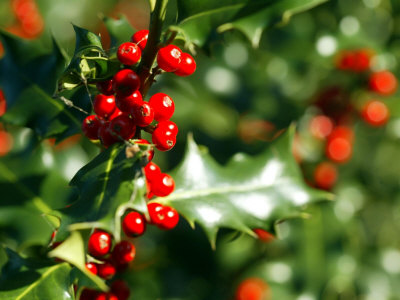
Holly is commonly used all over the world as a Christmas decoration, a custom derived from the early Romans who sent boughs of Holly to friends during Saturnalia, the Roman festival of Saturn held around the 17th of December in celebration of the Winter Solstice.

An old Christian legend says that Holly sprung up under the footsteps of Christ as he trod the earth, the spines of the leaves became symbolic of 'Crown of Thorns', with the red berries representing the drops of blood associated with his suffering.
From this symbology the Holly tree became known as 'Christ's Thorn' or the 'Holy Tree'.


In pagan folklore the Holly tree is associated with the spirit of vegetation and the waning forces of nature, which are personified as a mythical figure called the Holly King.

The Holly King is often depicted as an old man dressed in winter clothing wearing a Holly wreath on his head and walking with the aid of a staff made from a Holly branch.

The Holly King gathering Mistletoe

As nature rests during the darkest time of the year, it will be after the Winter Solstice and celebration of Yule, that the days begin to lengthen again and the re-birth of the new light of the Celtic Sun God encourages fresh growth during the coming new year.

As with most other tree legends, the Holly was revered for its protective qualities. When planted around the home it protects the inhabitants and guards against lightening, poisoning and mischievous spirits and witchcraft. 
Carrying a piece of Holly promoted good luck, especially for men, as Holly is considered a male plant - even though there are male and female Holly plants, those with red berries and those without.

In winter, the Druids advised people to take Holly into their homes to shelter the elves and fairies who could join mortals at this time without causing them harm. But it must be completely removed before the eve of Imbolc - 1st-2nd Februaury -first day of Spring, -for even if one leaf remained in the house, it would cause misfortune.


Old Scottish traditions says that Holly branches should only be pulled and not cut from the tree, a method considered more fitting for a sacred tree. It was also considered unlucky to fell a Holly tree or burn its green skinned branches. Yet luck was increased if a small branch was kept and hung outside of the house, there it would continue to protect against lightning.

Holly water was sprinkled on newborn babies to protect them and it is said to help the bereaved to cope with death, and to ease their sleep with peaceful dreams.


The wood of the Holly tree burns very hot and so it was used by Blacksmiths to forge weapons and tools necessary for survival and protection. Smithies were revered for their ability to use the elements of fire and earth to create these items and it is for this reason the Druids associated Holly with the element of fire.
Holly is used to attract the powers needed for: Protection, Consecration, Healing, Peace, Goodwill, Luck and anything to do with the element Fire.


Ivy was held in high esteem among the ancients and its leaves formed the poet's crown. Ivy was dedicated to the Roman god Bacchus -the Greek god Dionysus - the God of Intoxication who is often depicted wearing a wreath of ivy and grapevines. He is also depicted holding a chalice and carrying a thyrsus (a wand) which was also entwined with ivy and vine leaves.


Ivy leaves were thought to prevent intoxication and the binding of the brow with ivy was seen to balance the effects of the vine. It was believed that if a handful of ivy leaves are bruised and gently boiled in wine and drunk, it would prevent intoxication.
Old English taverns bore a sign of an ivy bush over their doors, this was to indicate the excellence of the liquor supplied within, hence the old saying 'A good wine needs no bush'.

Throughout the ages ivy has been regarded as the emblem of fidelity, and Greek priests would present a wreath of ivy to newly married persons. Today the ivy is still commonly associated with weddings, and is carried or worn by bridesmaids.


If a women carried Ivy, it was said to aid fertility and general good luck. It was also said to ensure fidelity and from this came the custom of brides carrying Ivy. Ivy wherever it is grown or proliferates, guards against negativity and disaster. 
At one time, the custom of decorating houses and churches with Ivy at Christmas was once forbidden by the Christian Church, on account of its pagan associations.


Mistletoe grows in trees and in European legends is a symbol of fertility ( kissing under the mistletoe is still a tradition to bring people together ) and eternal life, perhaps because it remains green all winter. Many cultures have believed it to be heavenly or supernatural, because unlike most plants, mistletoe thrives without being rooted in soil and actually is a parasitic plant that lives off it's host tree.


Mistletoe has also been said to offer protection from sorcery and evil spells. The Druids believed that mistletoe had great healing properties, especially if it was gathered without the use of a knife and never allowed to touch the ground. Some Africans compare the mistletoe on a tree to the soul in the body, and they believe that mistletoe in a house brings good luck.

In Norse mythology, mistletoe was sacred to the beloved god Balder, but the evil god Loki used trickery to kill Balder with a stalk of mistletoe fashioned into a dart.


Saturday, 18 December 2010

Oak Moon

Decembers Full Moon is known as the Oak Moon and to the Algonquin Indians it is known as the Cold Moon.


The Oak was sacred to the Druids, who revered it for it's strength, endurance and permanance as it solidly weathers the harshness of winter.
The Oak has a habit of being struck by lightning during storms and so it is frequently associated with the various Gods of thunder and lightening, including Zeus, Thor, Jupiter, and the Lithuanian God, Perkunas, where they are often depicted holding bolts of lightning and their hands.

The Oak was believed to protect those who sheltered beneath it, from being struck by lightning.
Oak Trees have also been associated with Herne of the Wild Hunt, in England, and Wodin, in Germany.
King Arthur's Round Table was reputedly made from a single slab from a giant Oak Tree.  


Related Posts Plugin for WordPress, Blogger...